Are The Damajagua Waterfalls Safe? Deaths, Rules And Guides
The 27 Charcos of Damajagua ask you to jump and slide through a mountain river, so the safety question is fair. Here is what actually protects visitors: certified community guides, mandatory helmets and life jackets, a river-level protocol, and firm age and health limits.
Short answer
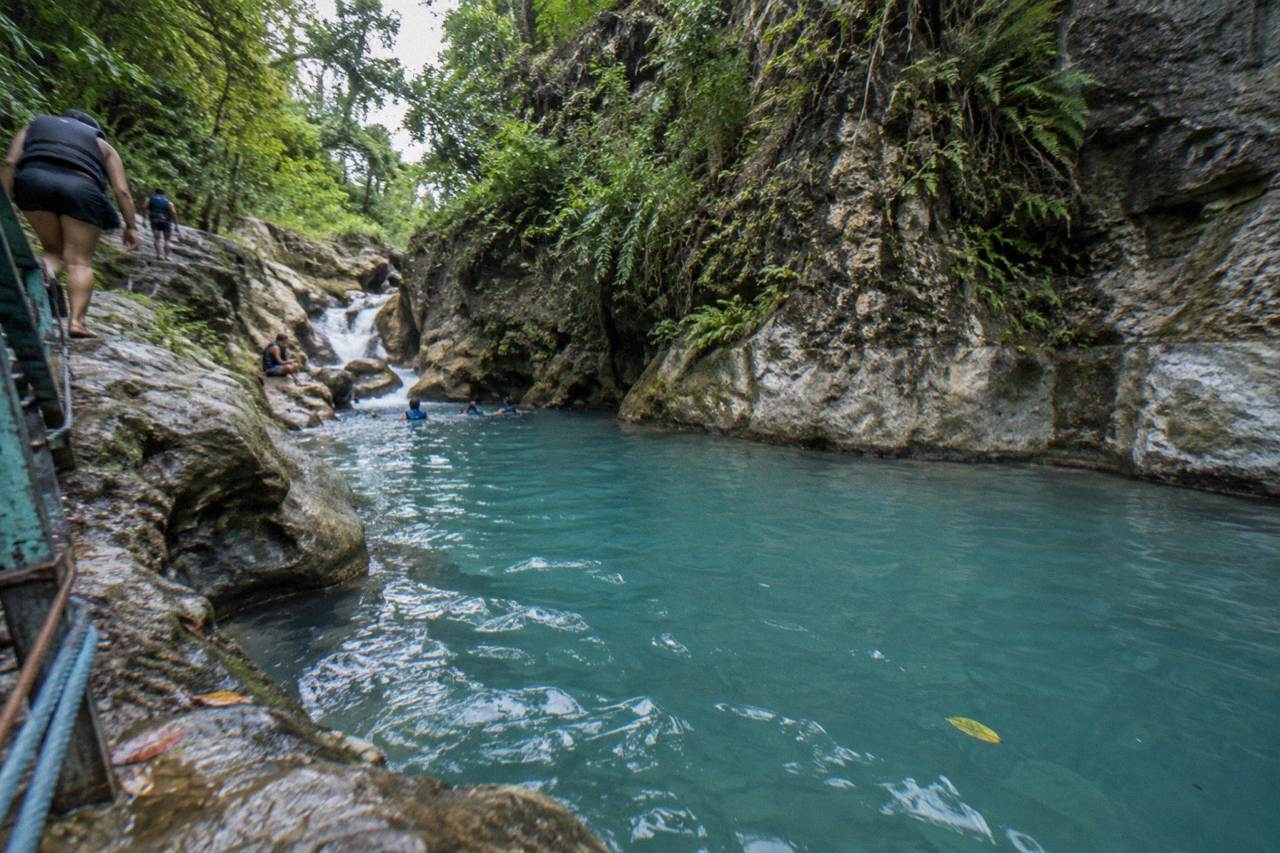
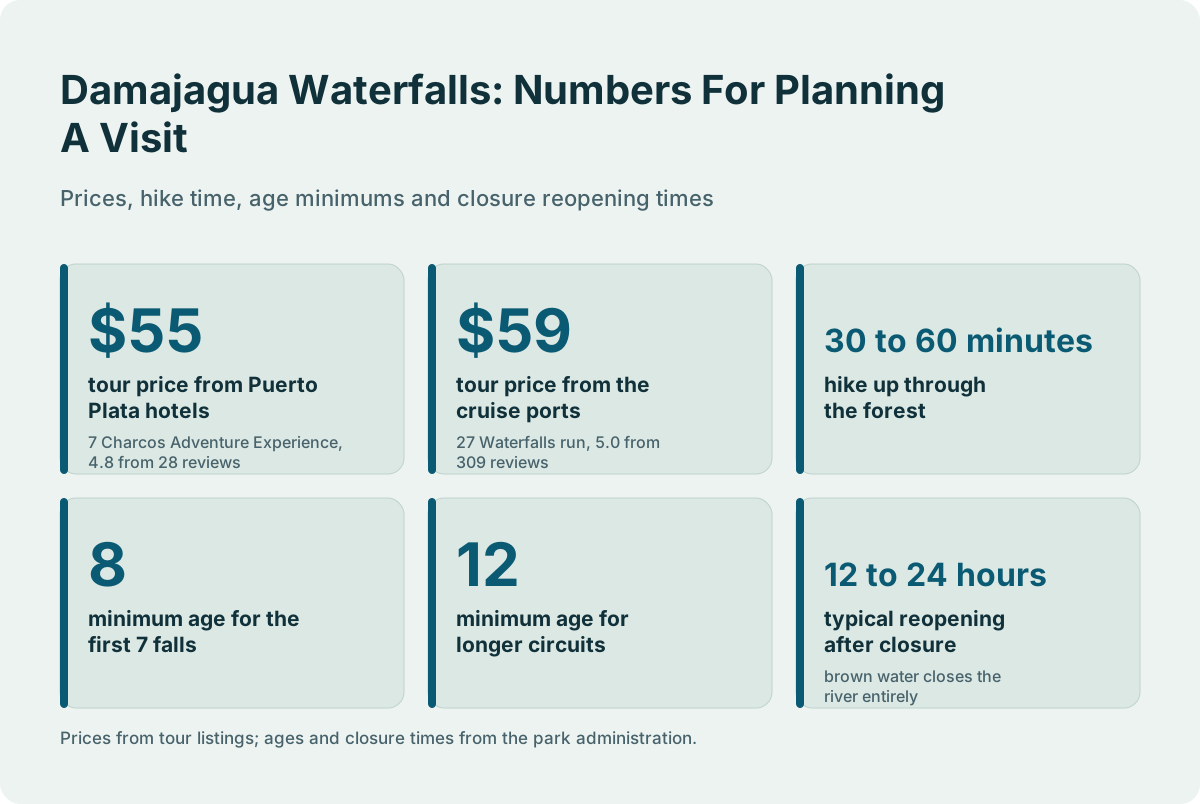
Damajagua is run as a guided canyon with mandatory certified guides, helmets and life jackets included in entry, and a river-level protocol that closes the upper falls first and shuts the river when it runs brown. Serious harm is rare but possible; the rules exist because the water is real. Minimum ages are 8 for the first 7 falls and 12 for the longer circuits.
People search "damajagua waterfalls deaths" because the photos show travellers dropping into dark pools between rock walls, and the internet is quiet on what happens when something goes wrong. The honest answer starts with how the place is run: the 27 Charcos, in the municipality of Imbert in Puerto Plata province, is not an open swimming hole. It is a protected natural monument, declared in 2004, co-managed by the Ministry of Environment and the local community guides' association, and nobody enters the canyon without a certified guide, a helmet and a life jacket. Those three things are not upsells. They are the entry ticket.
This page walks through the questions a nervous reader actually asks: whether people have died, why the guide rule exists, what the gear does, who should stay at the visitor centre, and what happens when the river rises. It also names real, bookable tours whose listings include the safety equipment and the guide, because for most visitors, especially cruise passengers on a clock, a tour is the simplest way to meet every rule at once.
Are The Damajagua Waterfalls Actually Safe?
Yes, in the way that any genuinely wild water is safe when the rules are followed: the canyon is run as a guided system, every visitor wears a helmet and a life jacket, a certified guide controls every jump and slide, and the park closes sections, then the whole river, when the water level rises. The danger is not hidden, it is managed, and the management is the reason the experience exists at all.
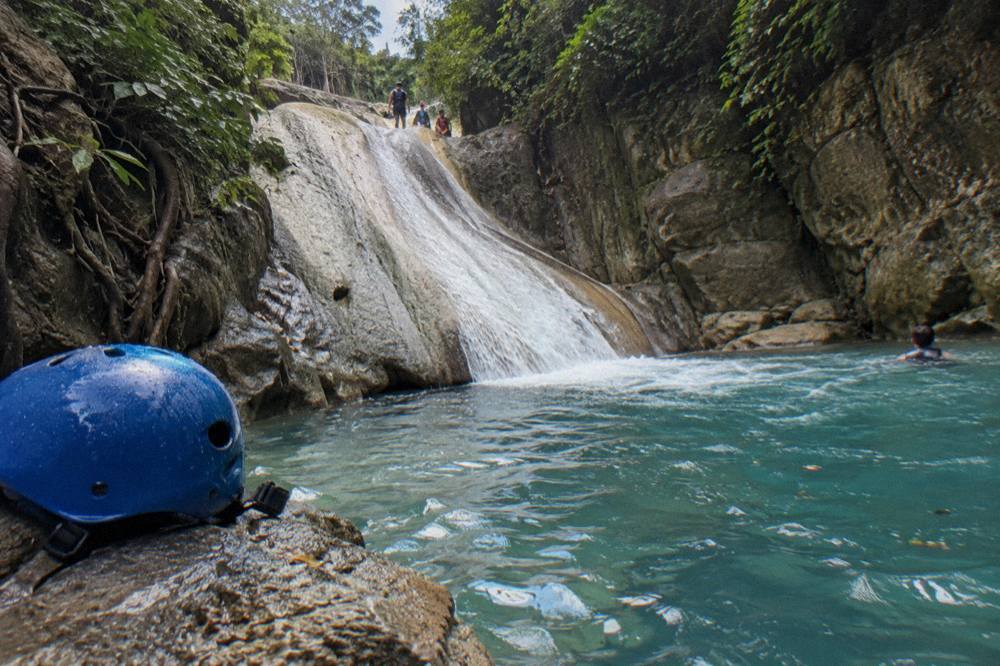
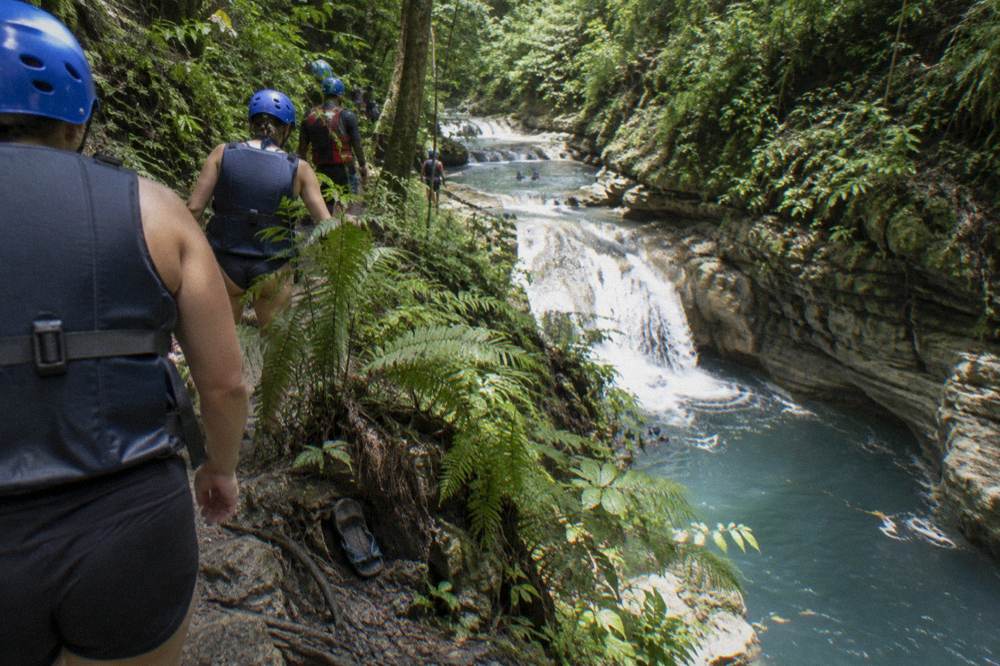
Start with what the experience is. You hike up through forest for 30 to 60 minutes, then descend through the water itself: sliding down smoothed rock chutes and jumping off ledges of varying height into deep pools, with the guide choosing the entry point for every drop. The life jacket keeps you afloat after the landing; the helmet protects your head from rock contact on slides; the guide's job is to read the water, test the depth, position you at the right spot, and give the go signal. Safety guidance on the 27waterfalls.org safety page, an independent portal, sets out a strict protocol: never jump before the signal, and never remove gear mid-canyon.
That last detail matters more than any statistic. Ask your guide about skipping any jump you do not want to take; guides choose the entry point for each drop, and a cautious visitor can still complete the route. The full 27 circuit is a different proposition: longer and more demanding, and only sensible for confident, fit people, which is why the site's fitness and difficulty guide treats it separately. Nothing about Damajagua is safe for someone who ignores the guide, and the operator community is blunt about that.
Have There Been Deaths At The Damajagua Waterfalls?
The park publishes no incident figures, and this page prints none. Every group climbs with a certified guide, helmets and life jackets are required, and the route closes when river levels run high. What is verifiable is the structure: mandatory guides, mandatory flotation and head protection, lateral ladders that let you skip some jumps, and day-of river-level closures. Ask your operator what is optional on the route you book. That structure is what a reader should weigh, not an unverifiable claim of a perfect record.
A word on why this section is short. Some visitor portals publish injury tallies and "zero fatalities" claims drawn from their own unpublished counts. This site does not repeat them: a self-published statistic with no public source is marketing, not safety information, and a page that says "no one has ever died here" invites the reader to relax for the wrong reason. What can be said, from multiple independent sources including the Hotel Platino visitor guide, is that local guides began organising expeditions in the late 1990s, and that the rules now enforced at the gate, guide, helmet, jacket, age minimums, grew out of that community system built to manage descents safely.
The practical takeaway for a worried reader: the risk at Damajagua is not random. It concentrates in specific behaviours the guides actively police, jumping before the signal, slipping ahead of the group, skipping the jacket on a hot day, and in specific conditions, high brown water after mountain rain, which closes the canyon. Control those two things, by listening and by checking the river status, and you have addressed the mechanisms behind essentially every canyon incident anywhere.
Why Is A Certified Guide Mandatory At The 27 Charcos?
Every visitor descends with a certified community guide, a rule enforced at the gate with no independent-canyon option; the guides test depths, set jump posture, position each person, run the go-signal protocol and carry out rescues and first aid. The guide system, not luck, is the single biggest reason this canyon is manageable for ordinary travellers.
The guides are locals from the villages around Imbert, organised through the association that co-manages the monument with the Ministry of Environment. This is their river. Guiding here began as an organised local trade in the late 1990s, and a share of your entrance fee funds the community and the canyon's protection, which is why the guide rule is also a conservation rule. When you book a tour rather than arriving independently, your operator works with these same guides; the difference is that transport, equipment handout, timing and lunch are handled for you, which matters a great deal when you are fitting the canyon into a port call.
For hotel-based travellers from Puerto Plata, a listing such as the 7 Charcos Adventure Experience (from $55 per person, 4.8 from 28 reviews) bundles the guided descent with transport from the city; check availability on the live listing for your date. Cruise passengers have the widest choice of all, and the most reviewed options are built around the ports.
The Damajagua 7 waterfalls excursion from Amber Cove and Taino Bay runs 4 hours from $44, rated 4.8 from 617 reviews, with port pickup, lunch and gate entry included. The 27 Waterfalls run from Amber Cove, Taino Bay and Puerto Plata starts at $59 and carries 5.0 from 309 reviews. Whichever you choose, the guide ratio and gear handout happen at the visitor centre before you touch water.
What Do The Helmet And Life Jacket Rules Actually Require?
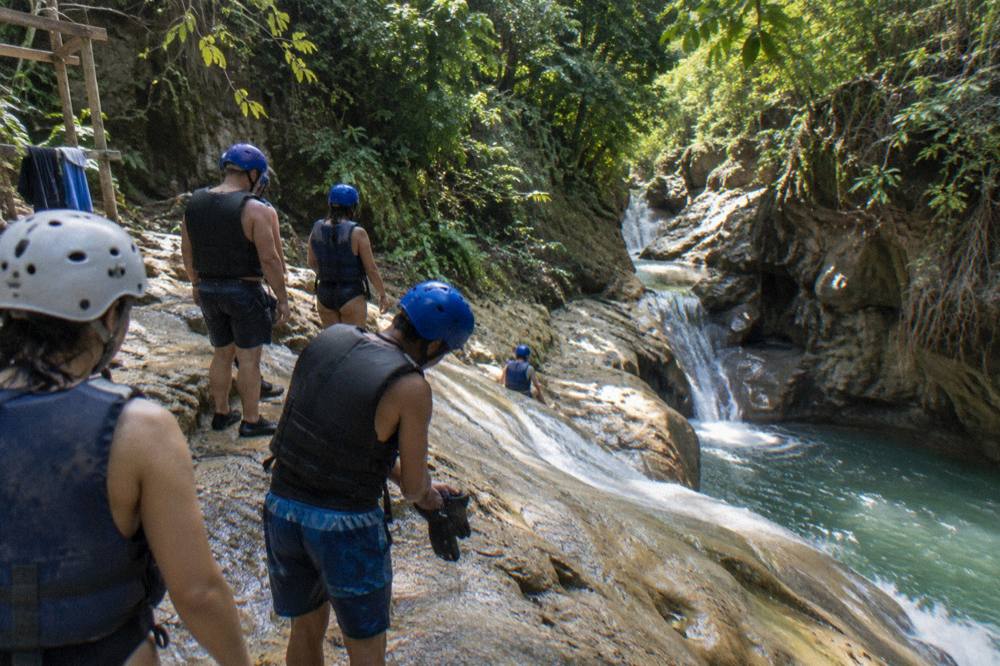
Entry includes a helmet and a life jacket, both mandatory, buckled at all times, for every visitor on every circuit, with no exceptions for strong swimmers; closed-toe water shoes are required in the water, flip-flops and sandals are banned, and guides will stop anyone who unclips gear mid-descent. The equipment is provided, so you do not need to bring your own.
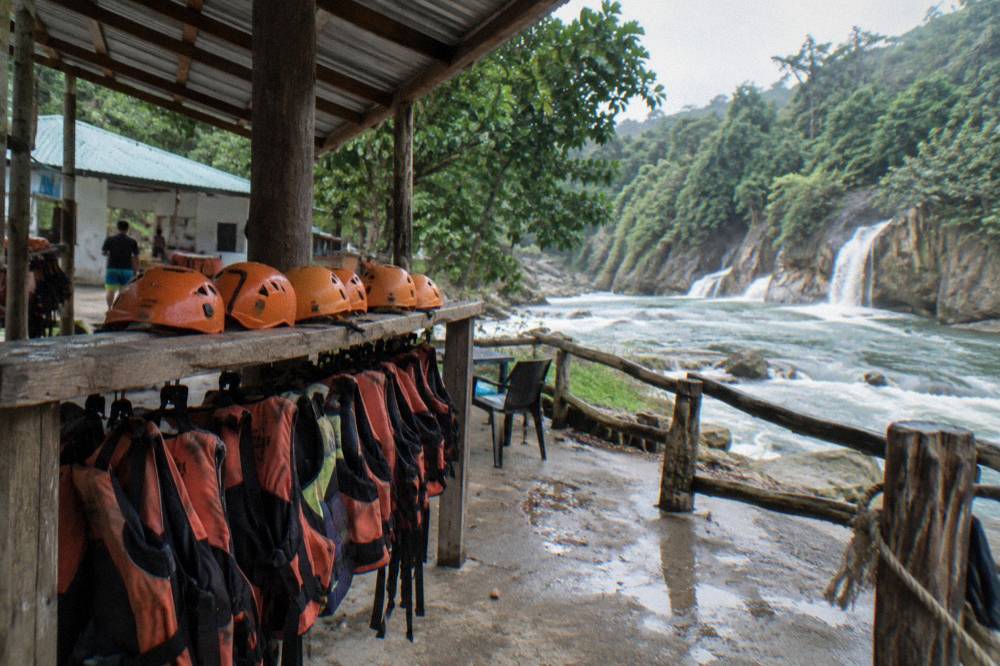
The life jacket is the piece people question, and it earns its place twice: it floats you after a jump, and it cushions your back and torso on the rock slides. The helmet is for the slides too, since the chutes are polished stone and the descent posture, arms crossed or protecting your nose, legs straight, puts your head close to rock. Water shoes are the third requirement: wet rock underfoot is the most common source of the minor scrapes and sprains any canyon produces, and grip is the cheapest prevention. Rentals exist at the visitor centre, and lockers too; both cost a few dollars extra, paid on arrival in cash. Jewellery, unstrapped sunglasses and loose phones are the standard losses, so leave them in the locker or use a strapped waterproof pouch.
Two rules sit beside the gear. First, jump posture is dictated: pencil vertical, feet together, arms in, on the guide's go signal only, never before. Second, the route down can be completed without the jumps; taking the easier way is normal, not embarrassing, and the choice stays with you. The table below summarises what the park provides versus what you carry in.
| Item | Provided with entry | Rule | Notes |
|---|---|---|---|
| Certified guide | Yes | Mandatory, never alone in the canyon | Community guides, at least two per group |
| Helmet | Yes | Buckled at all times | Needed for slides as much as jumps |
| Life jacket | Yes | Worn throughout | Flotation plus impact cushioning |
| Water shoes | No, rental on site | Closed-toe required in water | Old trainers with grip also accepted |
| Locker | No, paid on site | Recommended for valuables | Cash only, a few dollars |
| Photos | No, local photographers sell packages | Optional | Bring cash if you want the package |
Who Should Skip The Damajagua Waterfalls?
Visitor guidance for the park rules out visitors with heart problems, recent surgery or back injuries, pregnancy or severe reduced mobility, and minimum ages are 8 for the first 7 falls and 12 for the longer circuits. Comfort in water matters more than swimming skill, because the jacket floats you, but you must handle walking on wet, uneven ground.
The age rules come from the park administration and are enforced at the gate: children under 8 do not ascend, 8 to 12 year olds may do the first 7 falls, and 12 and up may do the longer circuits, subject to fitness and the guide's judgement. Families weighing this up should read the site's dedicated kids and age limits guide before booking, and ask the operator about height and weight limits for the jumps, since no reliable published figure exists for either. On the health side, the honest framing is this: the canyon is a hike plus repeated water landings, and anyone for whom either half is a strain should choose the shorter circuit or a different day out. One operator listing worth noting here is the Damajagua Waterfalls Tour with Lunch from Puerto Plata (from $65, 4.3 from 35 reviews), which explicitly offers a family-friendly slow-hike option with optional slides, a good fit for mixed-ability groups.
For non-swimmers the picture is more forgiving than people expect, and the site's non-swimmers explainer covers it in full: the life jacket is not optional decoration, it does the floating for you, and lateral ladders let you skip some of the jumps. Ask the operator what is optional. What the jacket cannot fix is panic, and nobody should book a canyon descent to test that.
What Happens When The River Rises After Rain?
The river can rise fast after rain that fell in the mountains upstream, even while the canyon itself stays sunny. Rangers judge access on the day from water colour and flow: normal clear flow opens all circuits, moderate flow limits the canyon to the first 7 or 12 falls, higher flow keeps only the first 7, and brown water closes the river entirely, typically reopening 12 to 24 hours after the rain stops.
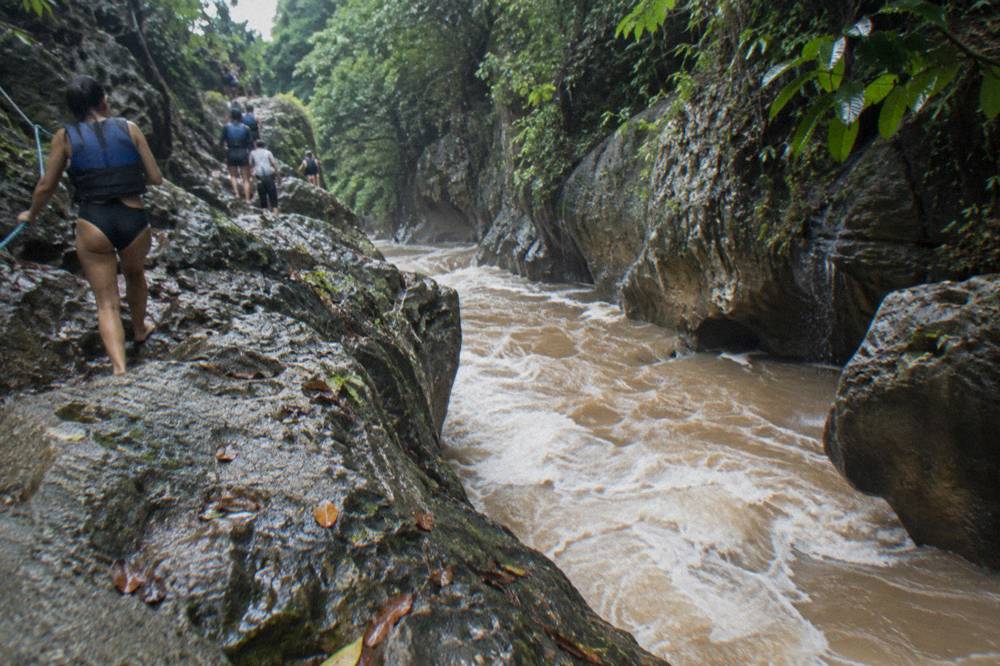
This protocol is the most important safety system at Damajagua and the least discussed. Rangers watch the river and judge its color and flow before deciding what opens on the day. The closure ladder runs from everything open down through partial closures that shut the upper falls first, to total closure when the water runs brown and fast, because brown means zero visibility, strong current and floating debris. Their call on the day is final. Reopening typically follows within 12 to 24 hours of rain stopping, as levels drop and clarity returns. The site's full rain closure explainer covers the seasonality, but the short version: dry season December to April brings clearer water and more visitors, wet season May to November brings more forceful falls and a higher chance of partial closure, with the highest tropical-storm risk in September and October per the National Hurricane Center's season climatology.
Two practical implications. First, a drizzly morning is not a cancellation: moderate drizzle at normal levels can still allow a visit, often with thinner crowds and more dramatic water, at the cost of slippery paths. Second, if you are in port for one day and the river closes, a listing with free cancellation and a full-refund-if-the-ship-cancels clause protects your money. The Damajagua Waterfalls Adrenalin Adventure from Amber Cove and Taino Bay (from $79 per person, 4.8 from 405 reviews) lists a full refund if the ship cancels, national park fees, water, snacks and rum punch, with a group capped at 16.
Smaller caps mean fewer people per guide at each pool, which is the format safety-minded readers tend to prefer. If you want the full analysis of format against price, the site's tour options comparison breaks the roster down by departure point, group size and inclusions.
Which Tours Handle Damajagua Safety Best?
Look for three things in a listing: gate entry listed as included, so the ticket, guide and gear are confirmed in one price; a stated group cap, because fewer guests per guide means more attention at every jump; and free cancellation, so weather or a changed port day costs you nothing. The roster's largest-cap runs go up to 100 guests, while small-group options cap at 10 to 20, and the difference in canyon feel is real.
A listing's inclusions are the cheapest safety signal you will get. Every operator supplies the mandatory guide, helmet and jacket, because the park requires them, but listings differ on whether the gate ticket itself is included, whether lunch is covered, and how many people share one descent. The table below pulls the safety-relevant facts from real listings on this site's roster.
| Listing | From (per person) | Rating and reviews | Group cap | Gate entry | Free cancellation |
|---|---|---|---|---|---|
| 7 Charcos Adventure Experience | $55 | 4.8 from 28 reviews | up to 60 | Not stated | listed |
| 27 Waterfalls Damajagua (Amber Cove, Taino Bay, Puerto Plata) | $59 | 5.0 from 309 reviews | up to 50 | included | listed |
| Damajagua Waterfalls Adrenalin Adventure | $79 | 4.8 from 405 reviews | up to 16 | park fees included | listed, full refund if ship cancels |
| Damajagua Waterfalls for Cruise Ship Passengers | $89 | 4.8 from 376 reviews | up to 20 | Not stated | listed |
| Waterfalls of Damajagua and Lunch Included | $60 | 4.9 from 29 reviews | up to 11 | included | listed |
| Damajagua Waterfalls Private Tour (Amber Cove, Taino Bay) | $360 | 4.9 from 30 reviews | private | Not stated | listed |
Read that table as a spectrum rather than a ranking. The big-cap runs from the ports are the most reviewed and the cheapest per head, and the guide system keeps them orderly, but a family that wants a gentler pace, or a nervous first-timer, will feel the difference in a group of eleven versus fifty. Cruise-only visitors with a tight all-aboard should favour listings that name the port, name the pickup, and carry the ship-cancellation refund; the site's cruise day timing guide works through the clock math. Hotel guests in Puerto Plata have the widest choice and the least time pressure, and can afford to pick on group size alone.
One more comparison worth making before you book: what a tour adds over arriving at the gate independently.
| Element | Independent visit at the gate | Typical organised tour |
|---|---|---|
| Guide, helmet, life jacket | Included in gate entry | Included, handed out at the visitor centre |
| Gate fee | Cash only at the booth, roughly US$11 to 21 by circuit | Listed as included on many listings, check each one |
| Transport | Arrange your own; Imbert is about 28 minutes from Puerto Plata | Pickup listed on most listings |
| Timing flexibility | You choose; arrive before 9 AM to beat cruise groups | Fixed to your pickup, matched to port or hotel |
| Lunch | On-site buffet at your own cost | Included on most listings |
| Weather refund | None | Free cancellation listed on nearly all roster tours |
The gate price is roughly RD$600, RD$900 and RD$1,200 for the 7, 12 and 27 circuits, about US$11, US$16 and US$21, cash only and subject to change; the site's tickets and entrance fee guide covers the detail. For a solo traveller with a rental car the independent route works. For nearly everyone else, the tour is the version of Damajagua where nothing about safety is left to figure out on the day.
That cruise-passenger listing runs about 5 hours with port pickup, buffet lunch including local rum drinks, guide, helmet and jacket.
Common Questions About Damajagua Waterfalls Safety
Are The Damajagua Waterfalls Safe?
Yes, within a managed system: a certified guide is mandatory, helmet and life jacket are included in entry and must stay buckled, jumps happen on the guide's signal, lateral ladders let you skip some of them, and the river closes section by section when levels rise. Ask the operator what is optional on their route before you book. The danger is real water, managed by real rules.
Have There Been Deaths At The Damajagua Waterfalls?
The park publishes no incident figures, and this page prints none. What matters day to day is the safeguards: a certified guide accompanies every group, helmets and life jackets are mandatory, and sections close whenever river levels rise after rain. What is verifiable is the control system: community guides, mandatory gear, jump protocols and day-of river closures.
Do I Have To Jump At Damajagua?
Not necessarily. Lateral ladders let you skip some jumps, though not every obstacle can be avoided, and one operator lists the slides as mandatory on its adventurous hike. Ask ahead which parts are optional on your circuit. The full 27 expects more commitment than the first 7.
What Is The Minimum Age For The Waterfalls?
Children under 8 do not ascend; ages 8 to 12 may do the first 7 falls; 12 and up may do the longer circuits, subject to fitness and guide judgement. Ask your operator about height and weight limits for the jumps, as no reliable published figures exist.
Can Non-Swimmers Do The Damajagua Waterfalls?
Often yes, because the life jacket does the floating and is mandatory for everyone. You do need comfort in water and the ability to walk on wet, uneven ground. Panic, not swimming technique, is the real disqualifier.
Does The Canyon Close When It Rains?
The park closes the upper falls first as the river rises and shuts the river entirely when it runs brown, typically reopening 12 to 24 hours after rain stops. Rangers decide on the day from water colour and flow. Book a listing with free cancellation so a closure costs you nothing.