Damajagua Waterfalls Photos: What To Expect And How To Shoot
The Damajagua waterfalls photograph beautifully, and they are also an easy place to drown a phone. Here is what the scenery actually looks like, what the rules say about cameras, and what gear survives the descent.
Short answer
The 27 Charcos of Damajagua are a chain of turquoise pools and rock slides in a forested canyon near Imbert, about 28 minutes from Puerto Plata. Helmets and life jackets are mandatory for everyone. Camera policy is not published as a formal rule, so ask your operator before bringing a camera or GoPro.
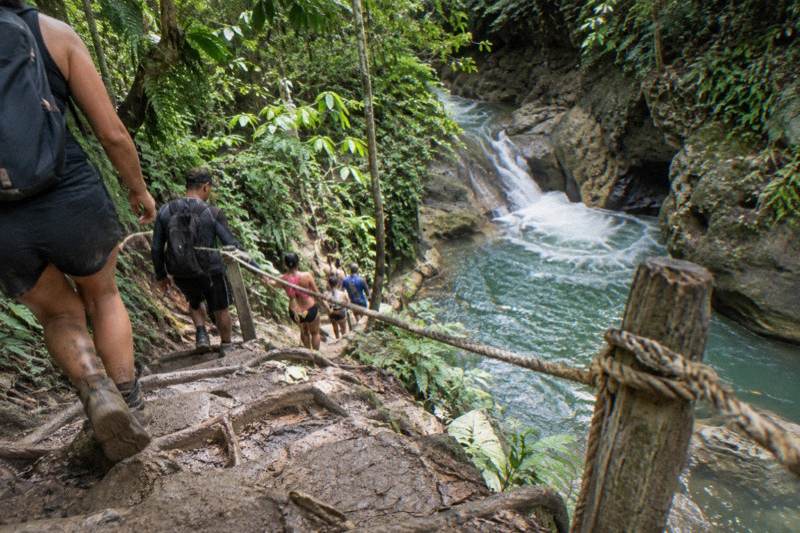
The Damajagua waterfalls sit in a narrow canyon of limestone and tropical forest, and almost every photo taken there looks better than the photographer deserved. Turquoise water, polished rock chutes, vines hanging over the rim: the canyon does the work. What the pictures do not show is the physics of the place. You reach the pools by sliding and jumping down them, wearing a helmet and a life jacket, which means every camera you carry has to survive water, impact and a guide who is watching the river rather than your exposure settings. This guide covers what the scenery actually looks like section by section, what the rules and operators say about cameras and GoPros, what gear holds up, and how the photo packages sold by local photographers work.
What Does The Scenery At The Damajagua Waterfalls Look Like?
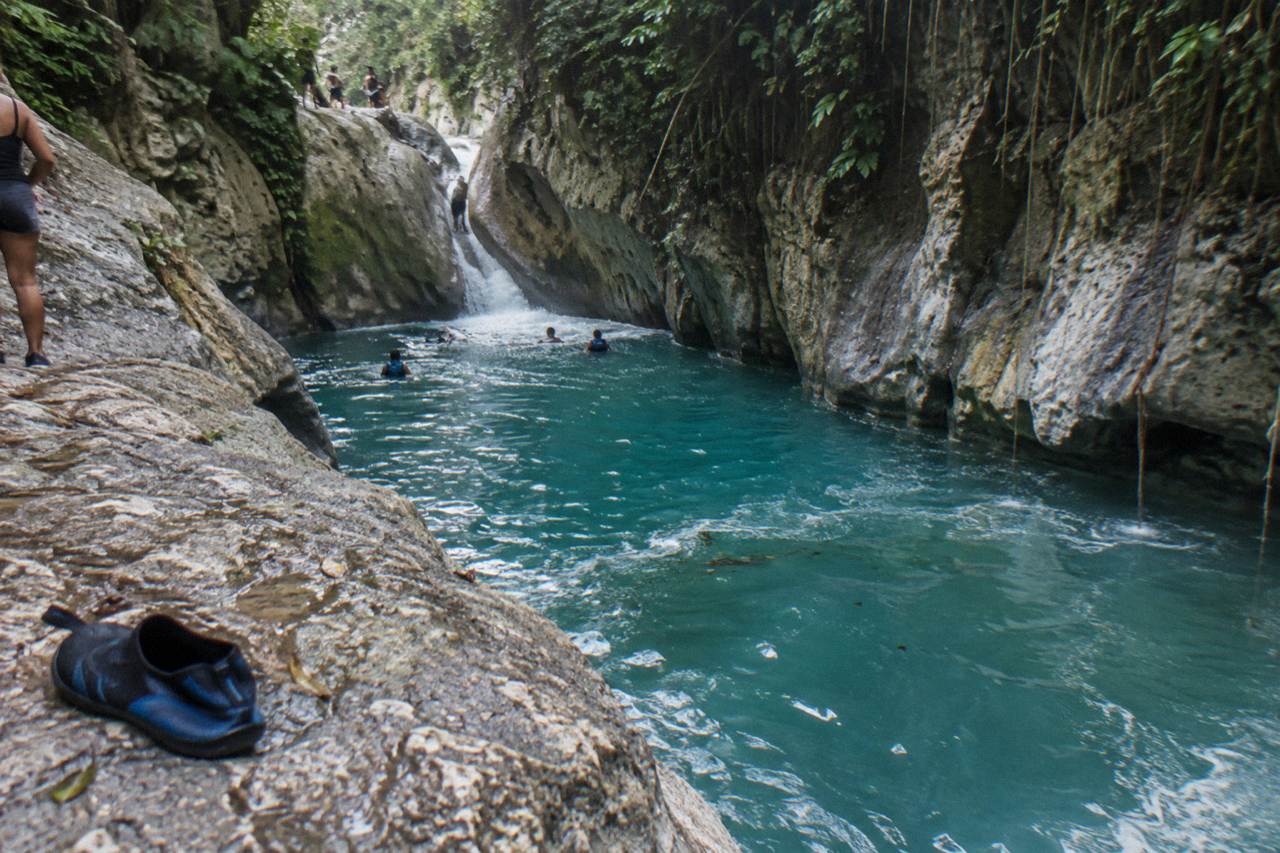
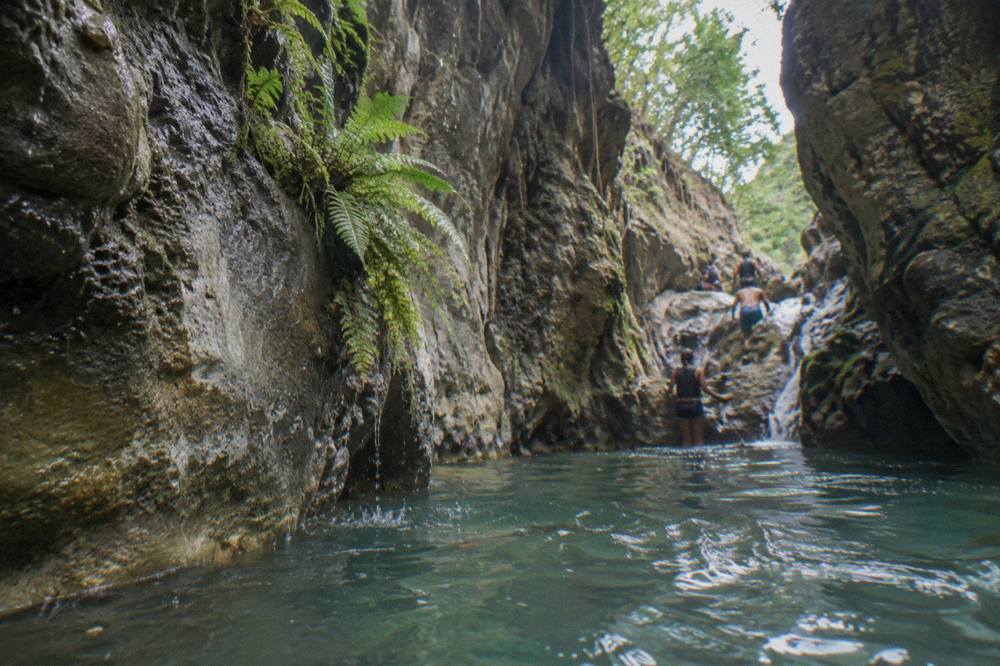
The canyon is a sequence of roughly 27 waterfalls and plunge pools cut into dark limestone, with clear turquoise water, overhanging tropical vegetation and polished rock slides linking pool to pool. Visitors only ever see one of three circuits, the first 7, the first 12, or the full 27, so most photos online show the lower, most accessible falls. The site is a protected Natural Monument declared in 2004, run under co-management between the Ministry of Environment and the local community guides' association, and it sits on the Damajagua river in the Cordillera Septentrional near the town of Imbert. The look changes with the light and the season: after dry weeks the water runs crystal and turquoise, and after rain it turns greener and then brown, which is when the park closes the upper falls first and can shut the river entirely. For more on that, see how rain changes the river.
Photographically, the canyon rewards two things: water colour and scale. The colour comes from mineral content and clarity, and it is the single biggest variable in whether your shots look postcard-grade or murky. Scale comes from people: a swimmer in a red life jacket against blue-green water is what gives the frames a sense of size, since the park publishes no jump heights and the pools are hard to read without a reference. Most visitors reach the water after a 30 to 60 minute walk up through forest, then descend through the water itself, sliding and jumping, which is why the photographic rhythm of the day is stop, shoot, jump, repeat.
The circuit you choose also decides your photo set. The 7-falls circuit, about 2.5 to 3 hours, covers the busiest and most shot pools. The full 27, about 4 to 5 hours, reaches narrower, wilder, far less photographed sections, but demands real fitness and carries more camera risk for longer. If you are deciding by picture potential, the guide on how many falls you actually visit breaks down what each circuit includes.
| Circuit | Typical duration | Minimum age | Photo character |
|---|---|---|---|
| First 7 falls | about 2.5 to 3 hours | 8 | The classic shots, busiest pools, most published images |
| First 12 falls | between the two | 12 for the longer circuits | Quieter upper pools, mixed light |
| Full 27 falls | about 4 to 5 hours | 12 for the longer circuits | Narrowest, wildest, least photographed canyon |
Can You Bring A Camera Or GoPro Into The 27 Charcos?
There is no verified published camera ban at Damajagua, but the camera policy is not formally stated anywhere, so the honest answer is to ask your operator before the day. What is verified: helmets and life jackets are mandatory for everyone, a certified guide is mandatory for every group, and anything not strapped on securely is likely to be lost in the water according to multiple visitor guides. In practice, small action cameras on chest or helmet mounts are the common sight in the canyon, and phones in sealed pouches are the second. The guides' association, which runs the site with the Ministry of Environment, has not published a gear page that loads, so treat any firm "cameras allowed" or "cameras banned" claim you read online with suspicion and confirm with the tour operator directly.
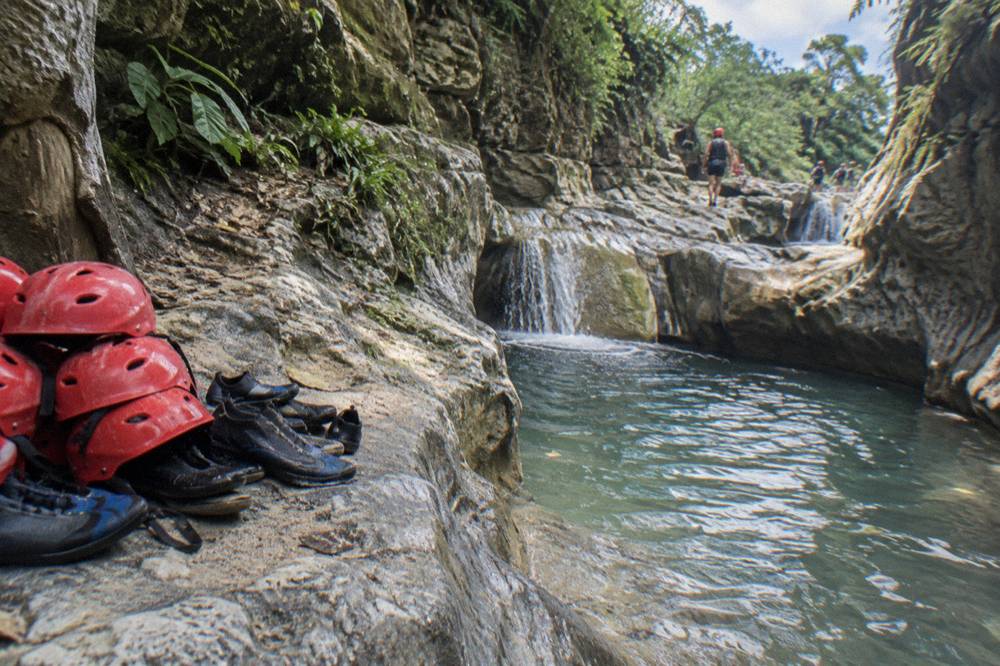
The risk is not a rule, it is the water. You descend by sliding down rock chutes and jumping into pools, sometimes with both hands needing to be free, and the visitor guidance is blunt that unstrapped cameras are regularly lost. A wrist lanyard is not enough on a slide; a chest mount keeps the camera out of your hands and survives the impact of a jump. Whatever you bring, the operator has the final word on the day, and guides can ask you to hand gear to the support staff for a particular drop if the entry point is awkward.
If you want photos but not the risk, there is a whole local economy built around that decision. Photographers from the surrounding communities shoot the groups as they descend and sell packages afterwards; the roster listings for several tours list "paparazzi" or photo packages under exclusions, meaning they are available to buy on site but not included. Package prices vary from one photographer to the next, so ask on arrival what the fee covers and how you get the files. Meanwhile, the question of what to wear to Damajagua matters as much as the camera, because closed water shoes with grip keep you upright on wet rock, and an upright photographer takes sharper pictures.
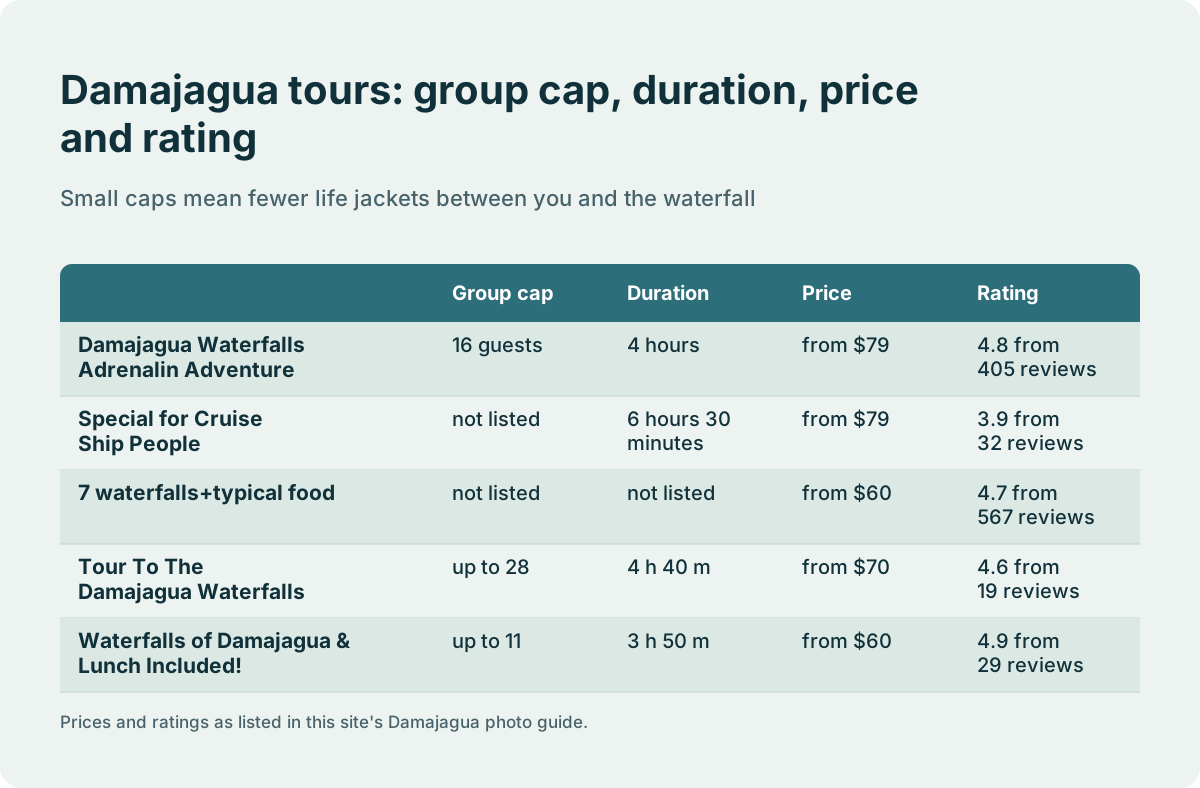
For a tour that keeps groups small, the 16-guest cap below is the standout; the card after it trades group size for a longer port day.
Damajagua Waterfalls Adrenalin Adventure caps groups at 16 guests, runs 4 hours from Amber Cove and Taino Bay, and holds a 4.8 rating from 405 reviews, from $79 per person. Prefer a longer port day? The Special for Cruise Ship People option stretches to 6 hours 30 minutes from $79 per person, rated 3.9 from 32 reviews, and suits travelers who value time in the canyon over a small group.
What Waterproof Gear Actually Survives The Damajagua Canyon?
A chest-mounted action camera in a sealed housing is the setup that most reliably survives Damajagua, followed by a phone in a locked waterproof pouch on a breakaway lanyard. Full-size cameras, removable lenses, drones and anything handheld without a tether are the gear most likely to end up in a pool, and visitor guidance repeatedly warns that unsecured cameras are lost in the water. The canyon punishes three things at once: water, impact on rock slides, and both hands being busy during jumps. The gear table below matches each option to what it survives.
| Gear | Survives water | Survives slides and jumps | Hands free | Notes for Damajagua |
|---|---|---|---|---|
| Action camera, chest mount | Yes, in housing | Yes | Yes | The standard setup seen in the canyon |
| Action camera, helmet mount | Yes, in housing | Yes | Yes | Angles down at jumps; check mount with guide |
| Phone in sealed pouch, lanyard | Yes if locked | Usually | No | Pouch advised by visitor guides; test the seal |
| Handheld action camera, wrist strap | Yes | Risky | No | Straps can slip on slides |
| Full-size camera, neck strap | Splash only | No | No | Leave in the locker at the visitor centre |
| Drone | N/A | N/A | N/A | Ask the operator; protected Natural Monument rules apply |
Two practical notes from the visitor guidance. First, the visitor centre at the entrance has lockers, and the standard advice is to leave valuables there rather than carry them into the canyon. Second, no camera rule is published, so confirm with your operator before arriving with anything expensive; some prefer gear handed to support staff at specific drops. The park itself only mandates the helmet, the life jacket and closed water shoes, and the helmet strap and jacket fit matter for photography too, since a loose jacket rides up on every jump and ruins the frame.
Batteries and storage deserve a line. Four to five hours in the canyon on the full 27 circuit, in heat and humidity, drains batteries faster than a normal day out, and there is nowhere to charge. Shoot short clips rather than continuous, and leave the phone in airplane mode. Fogging is the quiet killer of canyon footage: a housing moved from air-conditioned transport into humid forest mists up fast, so let the camera acclimatise before sealing it.
If you would rather someone else handle the logistics while you handle the camera, a mid-size tour with the gate entry and equipment included removes half the morning's friction.
The Damajagua Waterfalls Adventure lists free cancellation, so a change of plans or a brown-river morning does not lock you in. If the river closes circuits, the listing's own terms spell out whether that means a reshuffle or a refund.
How Do Tour Photo Packages Work At The Waterfalls?
Local community photographers follow the groups down the canyon, shoot the slides and jumps from the rocks, and sell the images as a package at the end of the day, paid in cash on site. The packages are not part of any tour price: multiple roster listings explicitly list "paparazzi" or photo and video packages under exclusions, so budget separately and bring cash.
The quality argument for the packages is real. The local photographers know every pool, stand in the right spot for each slide, and use lenses and housing that survive the canyon full time. A guest with a phone pouch gets one angle, their own. The counter-argument is cost and duplication: if your chest-mounted camera works all day, the package is a nice backup rather than a necessity. Bring a strap or tether for your GoPro: the circuit mixes jumps, slides and swims between pools.
Tipping sits next to the package in the day's cash economy. Tipping the guides is customary, and the amount is your call. The same goes for lockers and water-shoe rental at the visitor centre: they exist, they cost a few dollars extra, pay on arrival, and exact prices vary. For the wider money question, dollars, pesos and tipping at Damajagua covers what cash to carry and when you actually need pesos.
One option that keeps the day simple for photographers is 7 waterfalls+typical food, from $60 per person with a 4.7 rating from 567 reviews, which lists helmets, life jackets, lunch and port or hotel pickup. Fewer moving parts on logistics means more attention for the water.
When Is The Best Light And Water Colour For Photos At Damajagua?
Mid-morning to early afternoon gives the best direct light in the lower canyon, while water colour depends on recent rain: crystal turquoise after dry spells, greener in moderate flow, brown and closed when the river runs high. The park opens daily 8:30 AM to 4:00 PM, and arriving before 9 AM is the standard advice to beat the cruise crowds that arrive mid-morning from Amber Cove and Taino Bay. The two variables fight each other. Early morning means emptier pools and softer colour in the water; late morning means sun hitting the pools but dozens of life jackets in every frame. On port days, and October 2026 alone brought 38 cruise calls to the two terminals, the middle of the day can be busy enough that composition becomes a subtraction exercise.
Seasonally, the dry season from December to April is the reliable window for clear turquoise water and the highest crowds, and the wet season from May to November brings greener water, fuller falls and the closure risk that peaks with September and October tropical weather. The park's response to rain is graded: normal clear flow keeps all circuits open, moderate flow limits the canyon to the first 7 or 12, high flow keeps only the first 7, and brown water closes the river entirely, typically reopening 12 to 24 hours after rain stops. A photographer's rule of thumb that falls out of this: shoot the morning after a dry day, and check with your operator about river status the day before.
For timing the whole day rather than just the light, the cruise day timing guide maps the port schedules against the park's hours, including the strict early-afternoon cut-off for the full 27 circuit.
Where Do You Leave Valuables While Shooting The Canyon?
The visitor centre at the park entrance has lockers, and the standing advice from every visitor guide is to leave valuables, dry clothes and anything not waterproof there before ascending. The gate and entry system is cash only, pesos or US dollars, so keep that cash separate from what you lock away, and note that entry includes the mandatory guide, helmet and life jacket but not lunch. The locker exists precisely because the canyon eats objects: watches, sunglasses without straps, and loose phones are the standard casualties. Jewellery and expensive watches are better left at the hotel or on the ship entirely.
What goes in the locker and what goes in the canyon is a short list. In: passport, wallet minus the cash you need, room key cards, dry towel, change of clothes, any full-size camera. In the canyon, on your body, sealed: one phone or action camera, a small amount of cash for the photo package and a tip, and nothing else. The life jacket has no pockets you can trust, and the helmet is not storage. For the full packing breakdown, see what to wear to Damajagua, which covers shoes, quick-dry clothing and the case against cotton.
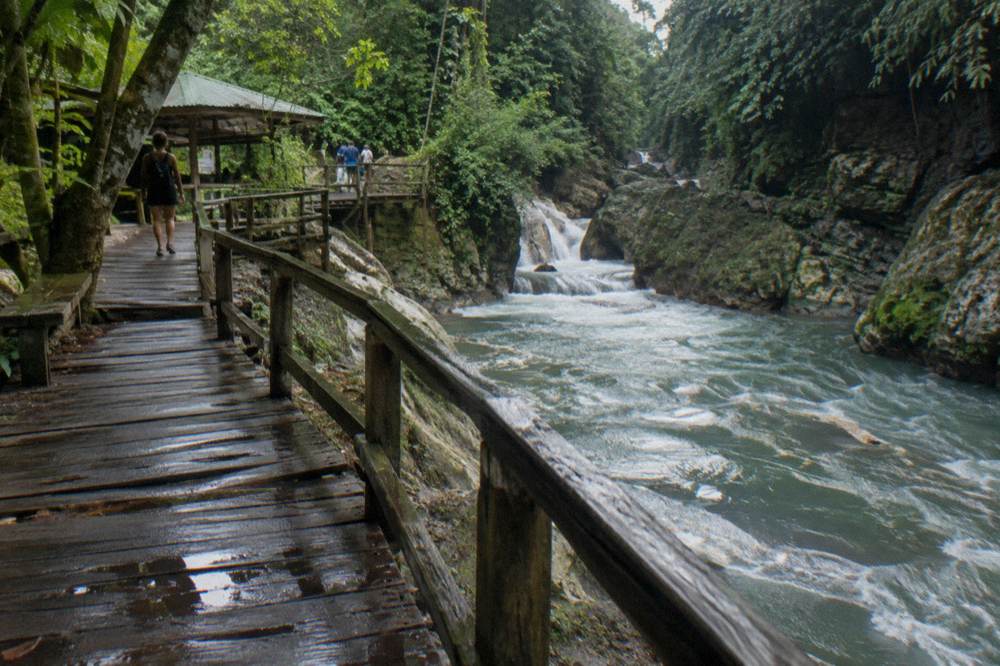
One more note that photographers keep learning the hard way: the walk up is 30 to 60 minutes through forest on a dirt trail, and the descent is through the water. There is no dry way out and no point in the middle where you can pop back to the locker. Decide what you are carrying before you start climbing.
Which Tours Give You The Best Photo Opportunities At The Falls?
Small-group and private tours give the cleanest frames, because fewer guests in the pool means fewer life jackets between you and the waterfall; on the roster, the smallest caps run from 10 to 28 guests, while the big port excursions run up to 47, 50 or 55. Circuit choice matters as much as group size: the full 27 reaches the least-photographed pools but doubles your camera's time at risk. The 7-falls circuit is where the classic shots live, and it fits the port-day timings from Amber Cove and Taino Bay, both about 20 to 30 minutes from the entrance.
| Tour | Group cap | Duration | Price | Rating |
|---|---|---|---|---|
| Tour To The Damajagua Waterfalls | up to 28 | 4 h 40 m | from $70 | 4.6 from 19 reviews |
| Waterfalls of Damajagua & Lunch Included! | up to 11 | 3 h 50 m | from $60 | 4.9 from 29 reviews |
| Damajagua Waterfalls Excursion with Lunch Buffet | up to 10 | duration on the listing | from $79 | 11 reviews, too few for a star claim |
| 27 Waterfalls Damajagua (port excursion) | up to 50 | 4 h 10 m | from $59 | 5.0 from 309 reviews |
| Damajagua Waterfalls Adventure | Not stated | 3 h | from $70 | 5.0 from 23 reviews |
For pure photography, the up-to-11 option, Waterfalls of Damajagua & Lunch Included, is the pick of that table: a 4.9 rating from 29 reviews, from $60 per person, with tickets, helmets, life jackets, lunch and private transport listed as included. At the other end of the scale, the cruise-port excursions keep their groups moving through the canyon on a tight timetable, and the most reviewed listing on the site, Damajagua The 7 waterfalls excursion at 4.8 from 617 reviews, runs from $44 per person, the lowest entry price on the roster.
The up-to-11 cap is the whole argument: with fewer than a dozen guests, the guides hold each pool longer, and the photographer in the group gets frames without arranging strangers.
What Shots Should You Actually Try To Get At The 27 Charcos?
The five frames that consistently work are the jump-from-above shot with the pool below, the slide sequence shot from the side, the canyon-rim vertical showing walls and vegetation, the group-in-blue-water resting shot, and the trail portrait on the forest walk up. All five are reachable on the 7-falls circuit, which is why it produces most of the canyon's published images. The jump shot is the hardest to self-shoot: you are, by definition, mid-air. That is the local photographers' core product. The slide shot works with a chest-mounted camera pointing forward, and the trail portrait is the one shot where a phone is genuinely the better tool, dry, steady, with even forest light.
Composition advice specific to this canyon: expose for the water, not the rocks, because the limestone walls go nearly black in the frames while the turquoise blows out. Shoot slightly down-angle from the ledges the guides stage groups on, and let the life jackets provide the colour contrast. Video-wise, short clips of each slide entry cut together tell the day better than any single still, and 4 to 5 hours of footage on the full 27 is more editing than most people ever do.
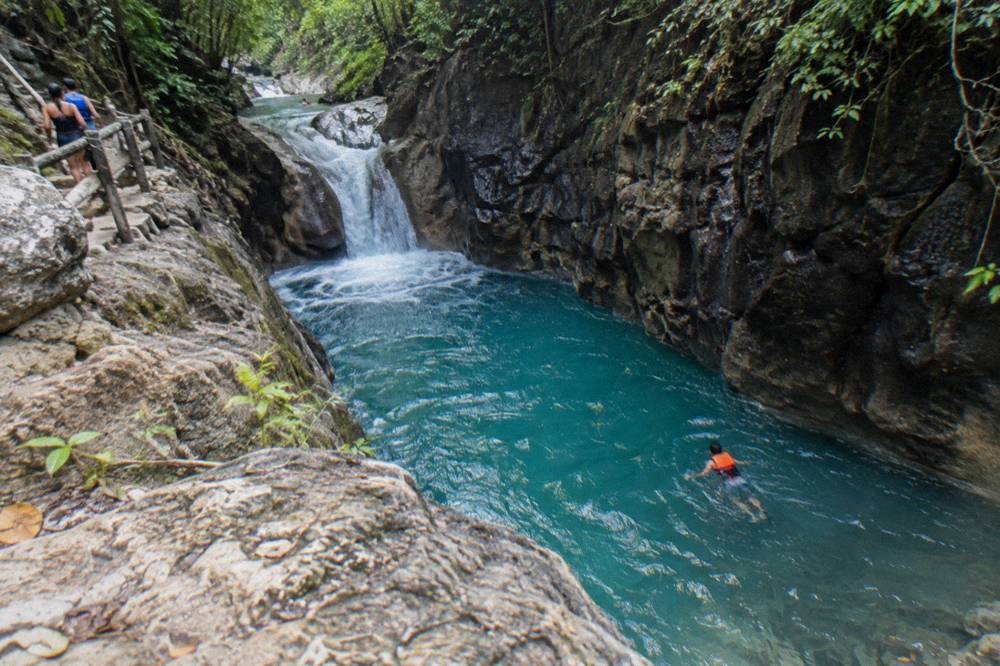
The safety framing matters for shots too. Guides choose the entry point and give the signal, and the verified safety guidance is that visitors jump only on the guide's "go". A photographer who delays a jump to adjust a mount is the person the guide is watching for. Lateral ladders let you skip some jumps, which is also how you can get ahead of the group for a downstream angle, with the guide's agreement. The safety and difficulty guide covers the fitness side of keeping pace with a group while shooting.
Do You Need A Tour To Photograph The Waterfalls?
No, independent visitors can arrive at the gate, pay the cash entry, which runs roughly RD$600 for the 7 falls, RD$900 for the 12 and RD$1,200 for the full 27, and hire a mandatory certified guide on the spot. But the gate fee covers only entry, guide, helmet and life jacket, not transport, lunch or the photo logistics, and the last entry for the full 27 closes around 1:30 PM. For a photographer travelling independently from Puerto Plata, the entrance near Imbert is about a 28 minute drive from the city centre, and public buses can drop at Imbert with local transport for the last stretch.
The trade is control against friction. Independent means you choose your arrival time, so you can be at the gate for 8:30 AM before the port crowds. A tour means someone else handles the cash-only gate, the shoes, the lunch and the river-status check, and on a port day that is worth real money in time. The full comparison, including what a tour price of roughly $60 to $95 typically bundles, is in whether you can visit without a tour.
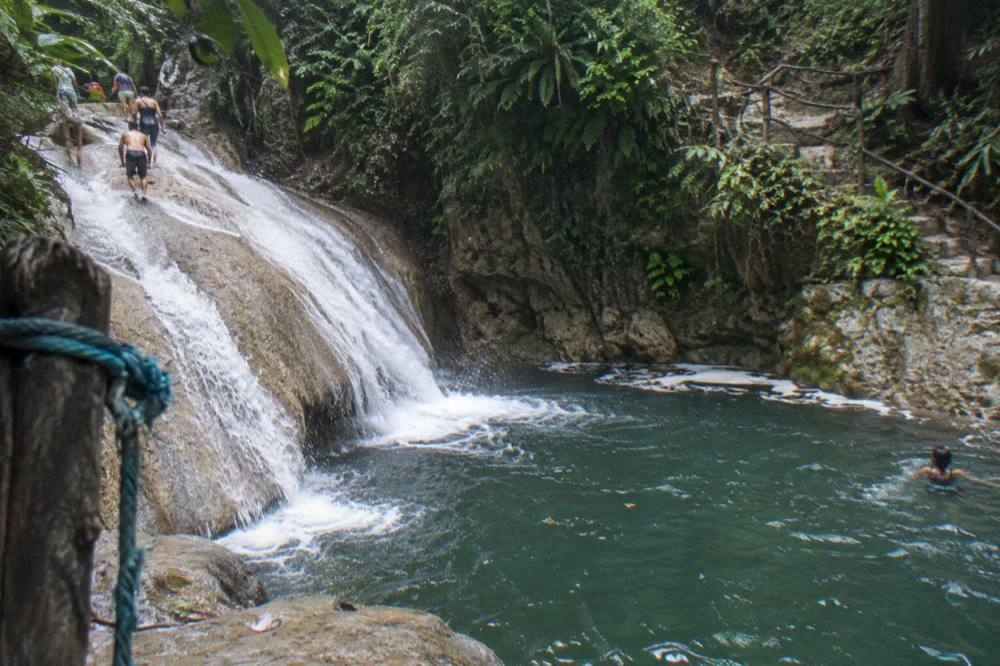
Either way, the images that come out of the 27 Charcos have a shared look, and it is not an accident: turquoise water, dark rock, green walls, red and yellow safety gear. The canyon supplies the palette. Your job is the seal on the housing and the answer to the guide's signal.
For readers deciding among the bookable options, the range runs from short hotel-pickup trips to full port days timed around cruise schedules, plus combos that add ziplines, monkeys or a city loop to the waterfall shots. Weighing category, duration and from-price side by side narrows the field quickly.
Whichever you choose, shoot the morning, seal the housing, and leave everything else in the locker. More on planning the whole day is on 27 Waterfalls Dominican Republic, including the port guides for Amber Cove and Taino Bay.
Common Questions About Damajagua Waterfalls Photos
Can You Bring A GoPro To The Damajagua Waterfalls?
There is no verified published camera ban, but the camera policy is not formally stated anywhere. Ask your operator before the day. In practice, chest- or helmet-mounted action cameras in sealed housings are common in the canyon, and visitor guides warn that anything not strapped on securely is likely to be lost in the water.
How Much Do The Photo Packages Cost At The 27 Charcos?
Local community photographers follow groups down the canyon and sell photo and video packages at the end, paid in cash on site. Prices are not published consistently and vary, so this site does not quote them; several tour listings show photo packages under exclusions, meaning they are a separate on-site purchase.
Where Do You Leave Valuables While In The Canyon?
The visitor centre at the entrance has lockers. The standard advice is to leave wallets, dry clothes, passports and any non-waterproof electronics there before the walk up, since the descent through the water offers no way back to the locker mid-circuit.
When Is The Best Time Of Day For Photos At Damajagua?
Mid-morning to early afternoon gives the most direct light in the lower pools, but arriving before 9 AM is the standard advice to beat the mid-morning cruise crowds from Amber Cove and Taino Bay. The park is open daily 8:30 AM to 4:00 PM.
Does Rain Ruin The Photos At The Waterfalls?
It changes them. After dry spells the water runs crystal turquoise, the best colour for photos; after rain it turns greener, and when the river runs brown the park closes the upper falls first and can shut the river entirely, typically reopening 12 to 24 hours after rain stops.
Do You Have To Be A Strong Swimmer To Shoot The Falls?
You must be comfortable in water and able to walk on uneven wet ground, but strong swimming is not required because the life jacket is mandatory for everyone. The full 27 circuit, about 4 to 5 hours, is far more demanding than the 7-falls circuit, about 2.5 to 3 hours.