Los 27 Charcos De Damajagua: What The Spanish Name Means
Charco is the Spanish word the whole canyon is named after, and it explains more about the tour than most English descriptions do.
Short answer
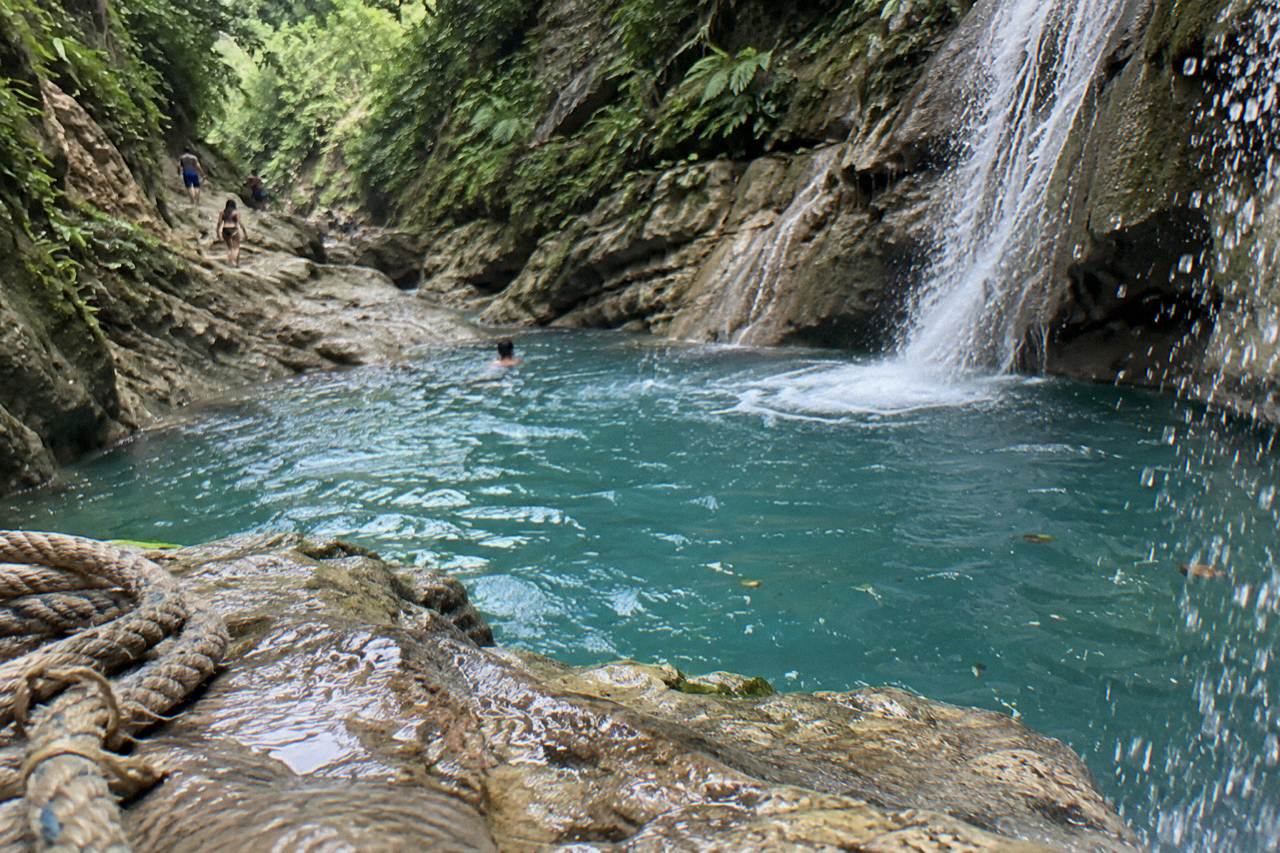
Charco means a pool or waterhole in Spanish, so los 27 charcos de Damajagua means the 27 pools of the Damajagua river, a canyon of waterfalls and swimming holes near Imbert, Puerto Plata. Tours sell three circuits: 7, 12 or all 27 charcos, and the name tells you exactly what you descend through.
A Spanish sign at the gate says 27 charcos, the bus driver says Damajagua, the excursion desk at the cruise port says 27 waterfalls, and they are all describing the same canyon. The Spanish name is the more precise one. A charco is a pool or waterhole, and the canyon near Imbert in Puerto Plata province is a chain of them, one below the next, carved into the Damajagua river. Declared a Natural Monument in 2004 and managed jointly by the Ministry of Environment and the local community guides' association, the site sells access in three doses: the first 7 charcos, the first 12, or the full 27. Which dose you buy is the single biggest decision of the day, and this page explains how the name maps onto that choice, how to say it, and which of the bookable tours fits each circuit.
What Does Los 27 Charcos De Damajagua Actually Mean?
The name breaks into three parts: charcos means pools or waterholes, Damajagua is the river and the rural area around it, and 27 is the count of waterfall-and-pool steps stacked along the canyon. So the full phrase means the 27 pools of the Damajagua river, a protected natural monument near Imbert, about 28 minutes by road from Puerto Plata.
The word charco is everyday Spanish. A puddle after rain is a charco, and so is a swimming hole at the bottom of a waterfall. In the Dominican Republic the word is used constantly for river bathing spots, balnearios, the places families drive to on Sundays. That is the frame locals bring to this canyon: not an extreme adventure park but a chain of river pools, developed by village guides who began organising expeditions there in the late 1990s.
Damajagua is the river and also the name of the rural area around it, inside the municipality of Imbert. The park entrance sits near Imbert on the road between Puerto Plata and Santiago, 4.9 km and about 8 minutes from the town itself. Overseas visitors usually arrive the other way, from Puerto Plata city centre about 29 km out, or from the cruise ports at Amber Cove, about 20 minutes, and Taino Bay, about 30 minutes, all free-flow estimates that traffic extends.
| Part of the name | Meaning | What it tells a visitor |
|---|---|---|
| Charco | Pool or waterhole in Spanish | The day is spent in the water, not looking at it |
| Damajagua | The river and the rural area around it | The site is rural Imbert, not Puerto Plata city itself |
| 27 | The count of linked cascade-and-pool steps | Three circuits exist: the first 7, the first 12, or all 27 |
The number 27 is a count of named cascades and pools along the river, not a marketing round number. What matters for planning is that nobody does all 27 in a casual morning: the full circuit is a 4 to 5 hour undertaking for fit visitors, while the first 7 charcos, the most common choice, takes about 2.5 to 3 hours including the walk in. The gap between those two experiences is the gap between a family outing and a genuine canyon day.
Is A Charco A Waterfall Or A Swimming Pool?
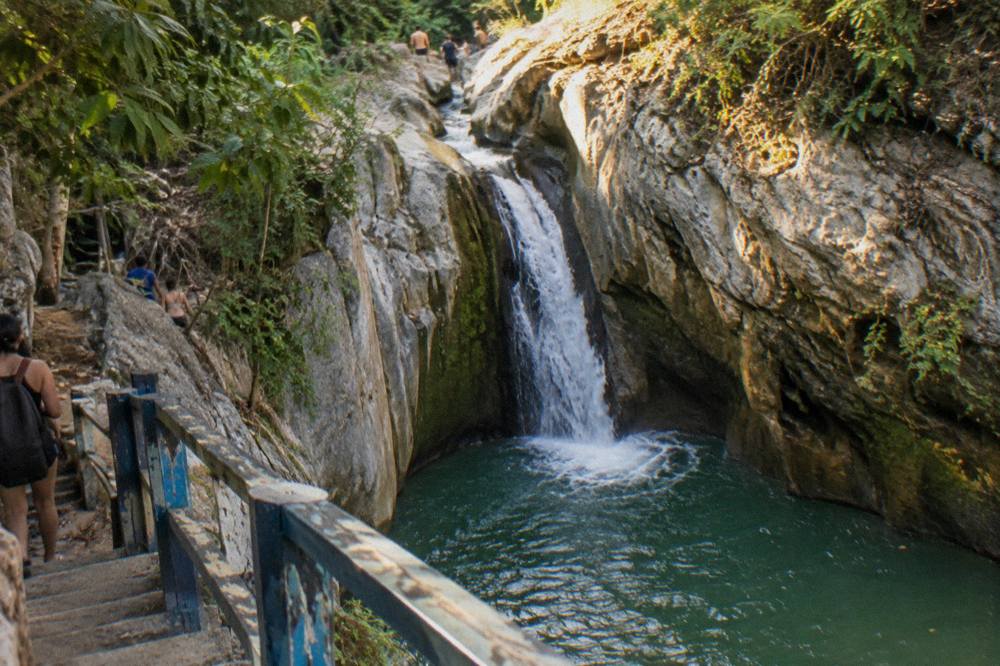
A charco is the pool, not the waterfall. Each of the 27 numbered stops pairs a cascade you jump or slide down with the plunge pool below it, so the tour is really a descent through 27 linked waterholes. English marketing flattens this into waterfalls, but the Spanish name puts the emphasis where the day is actually spent: in the water, wearing a life jacket, floating between jumps.
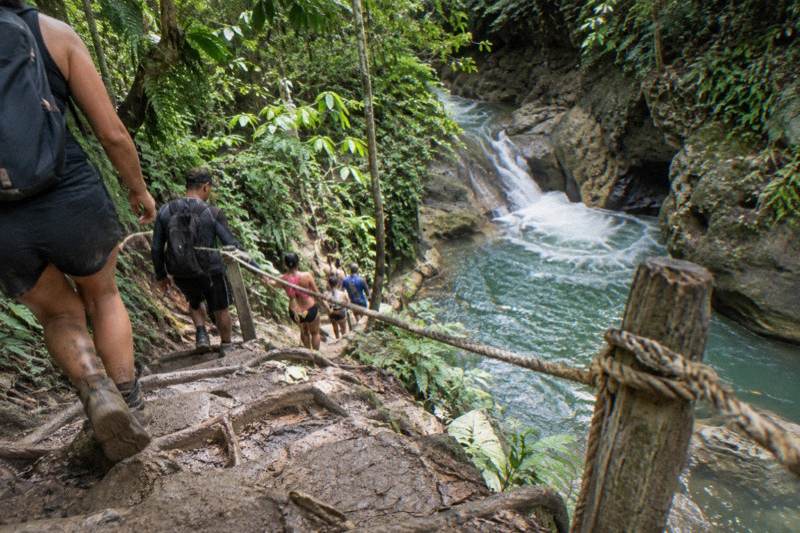
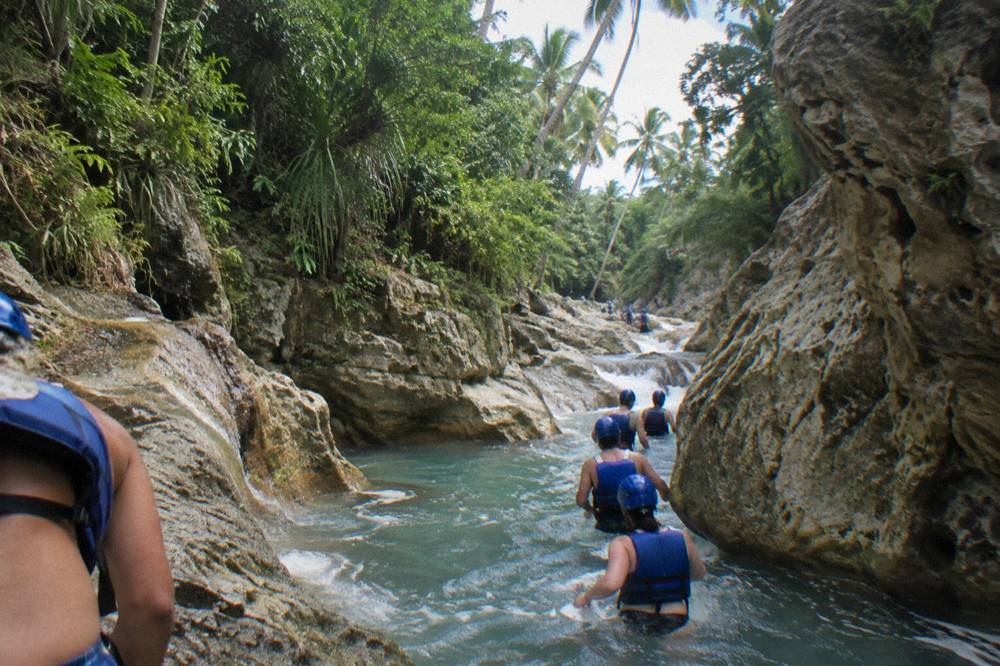
Picture the canyon as a staircase. Water comes down a step, fills a basin, then pours over the next lip into the basin below. Guides lead you up a forest trail first, a 30 to 60 minute walk, then you come down through the water itself: sliding on smooth rock chutes, jumping from ledges of varying height with guides choosing the entry point, and swimming or floating across each pool to the next descent. Ladders alongside some of the drops let you skip a jump you would rather walk past; ask your guide which ones are optional.
Because the pool is the destination, the experience is less about height and more about water. The river runs clearest in the dry season, December to April, when the pools sit turquoise and calm. After mountain rain the whole system changes fast, even when the canyon itself is under blue sky, and rangers close upper sections first, then the whole river when it runs brown. That responsiveness to weather is built into how the park operates, and it is why guides, helmets and life jackets are mandatory for everyone, provided with entry.
Swimming ability is the honest threshold. The visitor guidance is that strong swimming is not strictly required because the life jacket keeps you afloat, but you must be comfortable in deep water and able to walk on uneven, wet rock. Anyone booking should read the safety notes before committing, and the page on Damajagua waterfalls safety and deaths covers the health conditions the park lists as disqualifying, including pregnancy and heart problems.
How Many Of The 27 Charcos Do You Actually Visit?
Most tours visit the first 7 charcos, the standard circuit that takes about 2.5 to 3 hours and suits families and cruise timing. A smaller set of listings covers 12, and only fit visitors arriving before the roughly 1:30 PM cut-off attempt all 27, typically 4 to 5 hours. No ticket lets you cherry-pick: you do the first 7, the first 12, or the full count, always in sequence.
The numbering runs from the bottom of the canyon upward, which is why everyone does the same first seven. Those first seven charcos are the stretch most tours run. Charcos 8 through 12 and everything above them simply continue along the river, and the tallest jumps are reserved for the longer circuits. The longer circuits carry an age minimum of 12 and, for the complete route, the last-entry time.
Age rules follow the same ladder. The park's stated minimum is 8 years old for the first 7 charcos, with children under 8 limited to the base pools under supervision, and 12 for the longer circuits. These are the administration's rules as published by visitor portals and the local operator, so confirm the current wording with your tour before booking, especially for a child near a birthday cutoff.
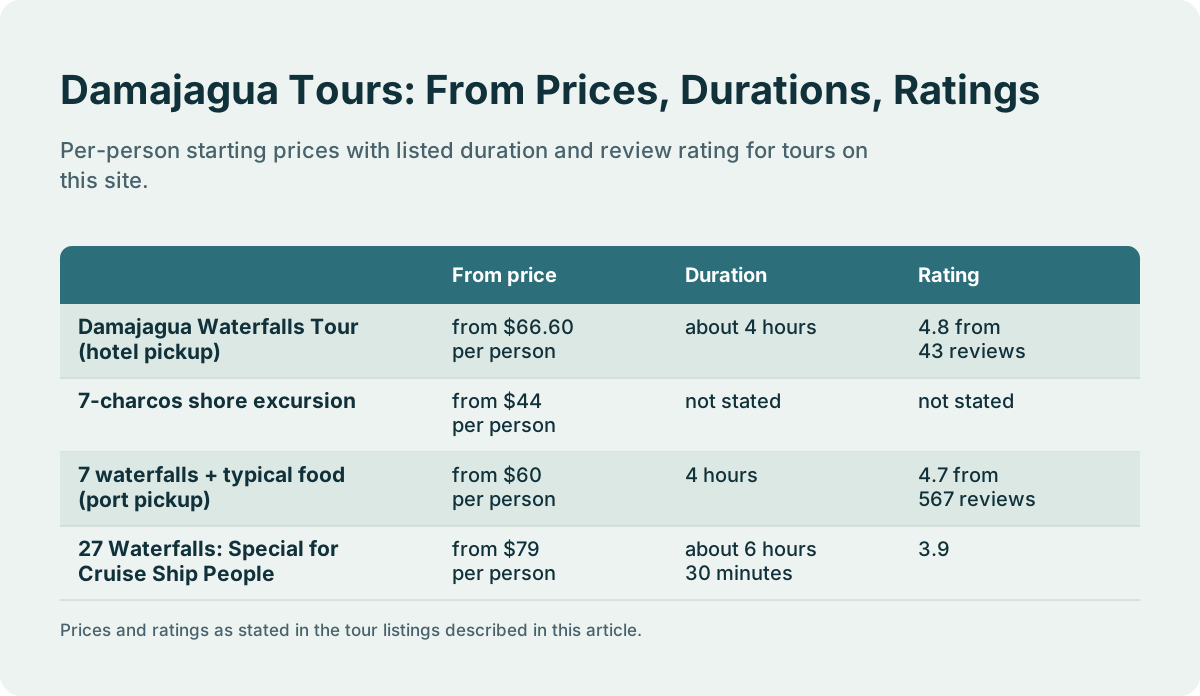
The practical match to bookable listings is straightforward. The 7 waterfalls plus typical food day runs 4 hours, rated 4.7 from 567 reviews, from $60 per person, with port and hotel pickup and a buffet lunch included. Visitors with a longer port day can look at the Special for Cruise Ship People trip: 6 hours 30 minutes, from $79 per person, rated 3.9 from 32 reviews.
Each of those two suits a different reader. The 7 waterfalls plus typical food tour, from $60 per person over 4 hours and rated 4.7 from 567 reviews, is the mainstream port choice, with pickup at both piers and lunch included alongside a taste of local cooking. For the longest day among the cruise-port tours, the 27 Waterfalls Puerto Plata: Special for Cruise Ship People listing runs from $79 per person over about 6 hours 30 minutes, rated 3.9 from 32 reviews.
Why Do English Sites Say 27 Waterfalls Instead Of 27 Charcos?
English marketing translates charcos to waterfalls because the literal word, pools, sells less convincingly to adventure buyers, and because the sites pair each pool with a cascade. The result is one canyon carrying two names: 27 charcos de Damajagua in Spanish and 27 Waterfalls of Damajagua in English, plus shorthand like Damajagua Falls, 27 Charcos, or the 7 Waterfalls tour for the standard circuit.
None of these are wrong, and none refer to a different place, which matters when you are comparing listings. A tour titled 7 Waterfalls and one titled 27 Charcos: 7 Charcos Adventure Experience may be near-identical products from different operators. The roster on this site shows exactly that spread: the 7 Charcos Adventure Experience listing from $55 per person, rated 4.8 from 28 reviews, and the 7 Waterfalls in Puerto Plata + a Delicious Local Lunch listing at the same from-price, 4.8 from 256 reviews. Similar names, different operators, different inclusions; never assume two listings are the same product.
| Name you will see | Language | What it refers to |
|---|---|---|
| 27 charcos de Damajagua | Spanish | The full canyon, all 27 pools |
| 27 Waterfalls of Damajagua | English | Same canyon, translated name |
| 7 Waterfalls tour | English | The standard first-7-charcos circuit |
| 12 charcos / 12 waterfalls | Either | The mid-length circuit |
| Damajagua Falls | English | Shorthand for the same site |
Spelling variants add one more layer. Damajagua is occasionally written Damajagüa with a diaeresis, the charcos are sometimes capitalised as Charcos or abbreviated, and Puerto Plata appears in some titles as the departure point rather than the site location, since the canyon is technically in Imbert. If a listing says Puerto Plata, it almost always means departure from Puerto Plata hotels or the cruise ports, not that the waterfalls are in the city.
Pronunciation trips up English speakers least in this pair. Damajagua is roughly dah-mah-HAH-gwah, four syllables with the stress on the third, and charco is CHAR-koh. There is a fuller walkthrough on how to pronounce Damajagua for anyone who wants the syllables broken down before talking to a driver.
Where Exactly Are The 27 Charcos Located?
The 27 charcos sit on the Damajagua river in the municipality of Imbert, Puerto Plata province, in the Cordillera Septentrional range of the northern Dominican Republic. The entrance is about 8 minutes from Imbert town, about 28 minutes from Puerto Plata centre, about 20 minutes from Amber Cove and about 30 minutes from Taino Bay, free-flow drive times that traffic extends.
The location explains the tour economics. Every excursion price on this site is mostly transport: an air-conditioned vehicle, a driver and a guide from the ports or the hotel zones to a rural trailhead. Independent visitors can reach the gate themselves, hiring a certified guide at the entrance, and Caribe Tours buses can drop at Imbert with local transport covering the last stretch, but the logistics and the cash-only gate make organised tours the default for nearly everyone, especially cruise passengers working against an all-aboard time.
| Starting point | Drive to the entrance | Distance |
|---|---|---|
| Imbert town | about 8 minutes | 4.9 km |
| Amber Cove cruise port | about 20 minutes | 18.5 km |
| Taino Bay cruise port | about 30 minutes | 28.4 km |
| Puerto Plata city centre | about 28 minutes | 28.9 km |
| Sosua | about 57 minutes | 51.8 km |
| Cabarete | about 1 h 11 min | 64.0 km |
Distances are moderate from every northern base. Sosua is about 57 minutes and Cabarete about 1 hour 11 minutes, both fine for a half-day trip, while Punta Cana on the east coast is about 5 hours each way, roughly 10 hours of driving round trip, which is why no honest planner sells the charcos as a casual Punta Cana day trip. From Santo Domingo it is about 2 hours 42 minutes each way, possible but long.
What Does Each Charco Circuit Involve, Time And Age Wise?
The 7-charco circuit takes about 2.5 to 3 hours, the full 27 typically 4 to 5 hours, and the 12 falls between the two. Everyone walks 30 to 60 minutes uphill through forest before the first descent. Ages run 8 and up for the first 7 charcos and 12 for the longer circuits, and the full 27 has a last entry around 1:30 PM, strictly enforced.
The uphill walk is the part listings underplay. You climb first, on foot, through forest, and then the reward runs downhill through the water. Fitness requirements scale with the circuit: the 7 is moderate and family-friendly, the 27 is for genuinely fit visitors, described by portals as demanding fitness and confidence in water. Wheelchairs cannot use the trail, and the park lists heart problems, recent surgery, back injuries and pregnancy as disqualifying conditions.
Not suitable does not mean no alternatives. One Puerto Plata listing, the Damajagua Waterfalls Tour with Lunch from $65 per person, rated 4.3 from 35 reviews, explicitly offers a family-friendly slow hike of about 20 minutes with optional slides for kids, elderly guests or anyone with mobility limits, alongside a harder adventurous route. That choice, printed on the listing, is worth more than any generic difficulty promise. For a fuller difficulty breakdown, see Damajagua waterfalls difficulty and fitness.
What you wear decides how the day feels. Helmet and life jacket come with entry; closed water shoes or old trainers with grip are required, no flip-flops in the water, with rentals available at the visitor centre for a few dollars, paid on arrival. Cameras and phones need secure waterproof mounts, because anything loose is likely to be lost in the water. The site's what to wear guide has the full kit list.
How Much Do The 27 Charcos Cost, At The Gate And Through A Tour?
At the gate, cash only, the 7-charco circuit costs roughly RD$600 (about US$11), the 12 about RD$900 (US$16) and the full 27 about RD$1,200 (US$21), each including the mandatory guide, helmet and life jacket but no lunch. Most booked tours run from $44 to $110 per person, bundling transport, gear and usually a meal, sometimes park entry too.
The gate price is small; the logistics are what you pay a tour for. Reading the roster's inclusion flags closely matters here, because similar prices hide different bundles. Some listings include gate entry, such as the 27 Waterfalls Damajagua excursion from $59 per person, 5.0 from 309 reviews, with admission tickets named in its inclusions. Others leave it out or say nothing, and a few skip lunch as well. Two listings at the same headline price can differ by a gate fee and a meal.
| Listing | From price | Rating and reviews | Duration | Gate entry | Lunch |
|---|---|---|---|---|---|
| Damajagua The 7 waterfalls excursion (Amber Cove & Taino Bay) | $44 per person | 4.8 from 617 reviews | 4 hours | Included | Included |
| 7 waterfalls + typical food | $60 per person | 4.7 from 567 reviews | 4 hours | Not stated | Included |
| 27 Waterfalls Damajagua (Amber Cove, Taino Bay, Puerto Plata) | $59 per person | 5.0 from 309 reviews | 4 h 10 min | Included | Included |
| Waterfalls of Damajagua & Lunch Included | $60 per person | 4.9 from 29 reviews | 3 h 50 min | Included | Included |
| 27 Waterfalls Puerto Plata: Special for Cruise Ship People | $79 per person | 3.9 from 32 reviews | 6 h 30 min | Included | Included |
The pattern in that table is the honest summary: port excursions cluster at $44 to $79, most with lunch included and several with gate entry listed, and small-group or longer variants sit above them. The Adrenalin Adventure listing from $79 per person, 4.8 from 405 reviews, caps groups at 16 guests and adds a full refund if the ship cancels, a clause cruise passengers should look for. At the budget end, an independent visit is cheapest on paper, roughly US$11 to 21 at the gate plus transport, shoes, lockers and lunch, all paid separately, all cash.
Tipping sits outside both prices. Tipping the guides is customary, they work in a community association whose income partly funds canyon protection, and amounts are left to the visitor rather than printed anywhere reliable. Lockers and water-shoe rental cost a few dollars extra at the visitor centre, paid on arrival.
Among the hotel-pickup options, the Waterfalls of Damajagua & Lunch Included listing stands out for its small cap: up to 11 guests, from $60 per person, rated 4.9 from 29 reviews, with entry, lunch, drinks and private transport all listed. For most Puerto Plata hotel guests, that combination of a small group and a fully bundled price is the value sweet spot on the roster.
Do The Charcos Close When The River Rises?
Yes. The Damajagua river responds to upstream mountain rain within as little as half an hour, even under sunny skies at the canyon, and rangers close the upper charcos first, then restrict visitors to the first 7, then shut the river entirely when it runs brown and fast. Reopening typically comes 12 to 24 hours after rain stops, once clarity returns.
The decision rests with rangers on the day, based on water colour and flow, and it is final. The practical consequences for a visitor are three. First, in the wet season, May to November, closures and reduced circuits are more likely, with September and October carrying the highest tropical-storm risk; the dry season, December to April, is the safer booking window. Second, a booking for the 27 can become a 12 or a 7 without warning, which is weather, not a tour failing. Third, a listing with free cancellation lets you rebook if a forecast turns, and most of the roster carries it.
Guides handle the water judgement, which is the deepest argument for the mandatory-guide system. Groups are never alone in the canyon, guides test depths and choose the entry points for jumps, and lateral ladders let anyone skip a drop. The full picture of river behaviour and reopening protocols is documented by the visitor portal that tracks the park's rain and river flow, and the season-by-season breakdown is on best time to visit Damajagua waterfalls.
One more weather nuance worth knowing: light drizzle at normal levels does not automatically close anything, and it can mean thinner crowds and more dramatic flow. Brown water is the hard line. If the river looks like coffee, the park is closed, and no operator can argue with that.
For a booking that anticipates the weather variable well, the 27 Waterfalls Damajagua listing from $59 per person, 5.0 from 309 reviews, lists free cancellation, admission tickets and lunch together, which is the combination a cautious planner wants: refundable, entry covered, fed regardless.
Whether you arrive as a Spanish speaker searching the original name or an English speaker following the waterfalls sign, the canyon itself makes no distinction. The 27 Waterfalls Dominican Republic roster covers every circuit and every departure point, and the name on the ticket, charcos or waterfalls, changes nothing about the water.
Common Questions About Los 27 Charcos De Damajagua
What Does 27 Charcos De Damajagua Mean In English?
It means the 27 pools of the Damajagua river. A charco is a pool or waterhole, and the protected canyon near Imbert, Puerto Plata province, holds 27 of them stacked in sequence, each pairing a cascade with the plunge pool below it. English sites usually translate the name as the 27 waterfalls.
What Is A Charco?
A charco is a pool or waterhole in everyday Spanish, from a rain puddle to a river swimming hole. In this canyon it refers to the basin at the bottom of each waterfall, the part of the circuit you actually swim, float and land in.
Are The 27 Charcos And The 27 Waterfalls The Same Place?
Yes. Both names describe the same Natural Monument on the Damajagua river near Imbert. Waterfalls is the English translation used in marketing; charcos is the original Spanish name. Tours titled 7 Waterfalls and 7 Charcos also refer to the same first section of the canyon.
Do You Visit All 27 Charcos On A Tour?
Most visitors do the first 7, which takes about 2.5 to 3 hours. Some tours cover 12, and only fit visitors who arrive before the roughly 1:30 PM last entry attempt the full 27, typically 4 to 5 hours. The minimum age is 8 for the first 7 charcos and 12 for the longer circuits.
How Much Does It Cost To Visit The 27 Charcos?
At the gate, cash only, entry is roughly RD$600 for 7 charcos, RD$900 for 12 and RD$1,200 for all 27, about US$11, US$16 and US$21, each including the mandatory guide, helmet and life jacket. Organised tours with transport run from $44 to about $110 per person.
Where Are The 27 Charcos Located?
In the municipality of Imbert, Puerto Plata province, on the Damajagua river in the northern Dominican Republic. The entrance is about 8 minutes from Imbert town, about 28 minutes from Puerto Plata centre, about 20 minutes from Amber Cove and about 30 minutes from Taino Bay, free-flow times.